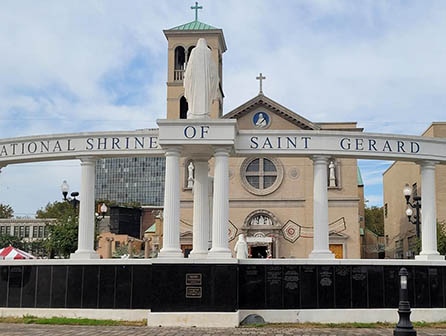
If your family was from the Old First Ward of Newark, chances are they attended St. Lucy’s Church on 7th Avenue. And the height of the year for that community was the Feast of St. Gerard. Thousands would come out to pay homage to the Saint, especially those that were trying to get pregnant or successfully gave birth to a healthy child.
Growing up I used to hear stories about my great-grandmother who would volunteer to help clean the church every morning after mass. The ladies would hide their cleaning rags behind their favorite saint after they were finished until the next morning.
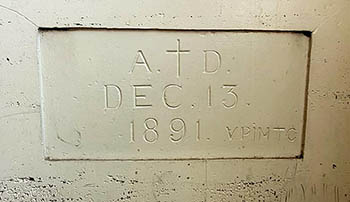
(credit: Andrea Lyn Van Benschoten)
The cornerstone was placed on St. Lucy’s feast day in 1891 and was the third Italian parish to open in Newark. It was organized as a mission church of St. Philip Neri, which was the first Italian parish in Newark. Father Perotti immigrated from Italy and settled in Newark in 1896. One year after his arrival, he was appointed pastor of St. Lucy’s and the church was officially separated from St. Philip Neri. Father Perotti was elevated to Monsignor, but he continued as pastor until his death in September of 1933. After Msgr. Perotti’s passing, Father Gaetano Ruggiero, who immigrated to Newark in 1921, was appointed pastor of St. Lucy’s in 1934. Father Ruggiero remained pastor until his death in 1966. Msgr. Joseph Granato was the next pastor and served with distinction for the next 54 years until 2009. I’ll tell you, he was a rock star whenever the feast was taking place. Everyone wanted to talk to him. St. Lucy’s continues to serve the Old First Ward, now under the leadership of Fr. Paul Donohue and the Comboni Missionaries.
Saint Lucy (Santa Lucia) was martyred in Syracuse, Sicily in third-century and is the patroness of those afflicted with diseases of the eyes. According to scriptures, Lucy’s mother wanted her to marry a pagan, but Lucy wanted to either remain celibate or marry a Christian. After several years, her mother agreed to cancel the wedding. However, the Emperor Diocletian had other ideas and had Lucy arrested and tortured, which included having her eyes plucked out. After she was killed, her eyes had been restored. This miracle has made her the patron saint of eye disease.
Within the walls of St. Lucy’s Church is the National Shrine to St. Gerard. In the late 1890s, Italians were emigrating from the Province of Avellino and making their homes in the Old First Ward. They came with a sense religious life deeply expressed in a love for St. Gerard, who also lived in the Avellino during mid-1700s.
In 1899, immigrants from Caposele, Italy introduced the annual feast in honor of St. Gerard, who died October 16, 1755. Every October the feast of St. Gerard continues to be a highlight for the parish. Generations of families who no longer live in the area “come home” to 7th Street to pay respect to St. Gerard… and remember.
The Saint is paraded through the streets, just as the immigrants did over 100 years ago. People make blankets of money and pray at his feet. Women who were told they would never have a child follow the procession with their baby in their arms; often named after him.
This upcoming weekend, the 124th Feast is taking place. I am the fourth generation of my family to participate. When I sit in that church in the quiet, I can feel them all around me. And I am thankful.

 This Is My New Jersey
Leave a comment