
In 2024, New Jerseyans were shocked when a 4.8 magnitude earthquake rocked our beloved state. While most New Jerseyans are familiar with the Ramapo Fault line, this fault was surprisingly not responsible for the 2024 rock and roll we experienced. New Jersey now has a new fault line.
Mountainville Fault
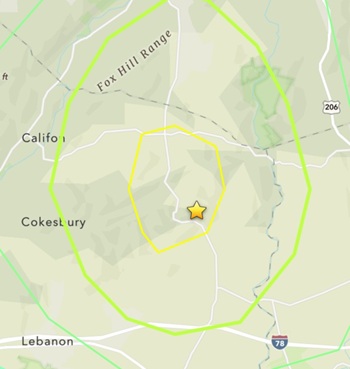
According to a recently published article in Advancing Earth and Space Sciences, the 2024 earthquake near Tewksbury was not a result of the Ramapo Fault, but the newly identified Mountainville Fault.
“We find that the up-dip projection of relocated aftershocks aligns with a zone of NNE-striking topographic (LiDAR) traces of fault scarps, marking a previously unmapped fault zone in the New Jersey Highlands, henceforth designated as Mountainville Fault.” ~Authors: F. Kolawole, E. Beaucé, Z. Foster-Baril, M. Colet, L. Seeber, J. Tielke, A. Prakash, W. Y. Kim, R. Ajala, C. McCarthy, F. Waldhauser
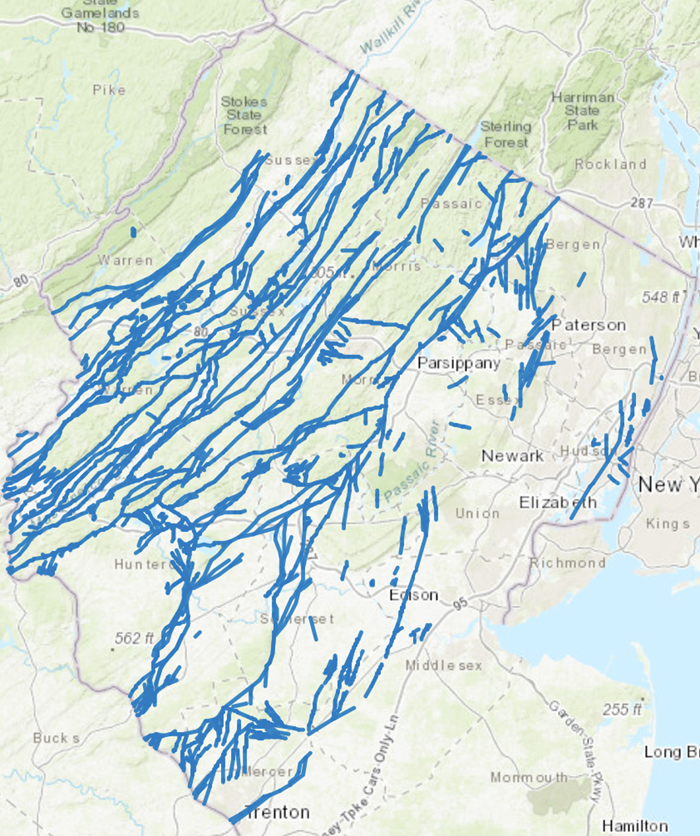
This is an astounding discovery. While many think of California as the epicenter for earthquakes, the truth is, New Jersey’s geologic makeup is far more complex. New Jersey’s oldest bedrock is significantly older than most surface features in California. The oldest rocks in the Garden State, found in the Highlands region, date back approximately 1.37 billion years. California, on the other hand, has major visible mountain ranges and active tectonic structures that are much younger; around 50 to 150 million years old. New Jersey’s fault lines run as far south as Trenton and as far north as Sussex County. So while California is over 150,000 square miles larger than New Jersey, turns out the Garden State is, once again, the OG. And I’m not surprised in the least. We all know Jersey rocks! Now we rock in more ways than one.


Leave a comment